
From unboxing to R&D showcase: building Kai in public on NVIDIA Jetson Orin Nano
2026 · Beta at DEVCON 17
Built onNVIDIA Jetson Orin NanoGoogle Gemma
Our founder Winston Damarillo brought home an NVIDIA Jetson Orin Nano Developer Kit. Here’s what the DEVCON Studios team and our Cohort 4 AI Engineering Interns built with it, in public, and how we can tell builder stories with your tech.
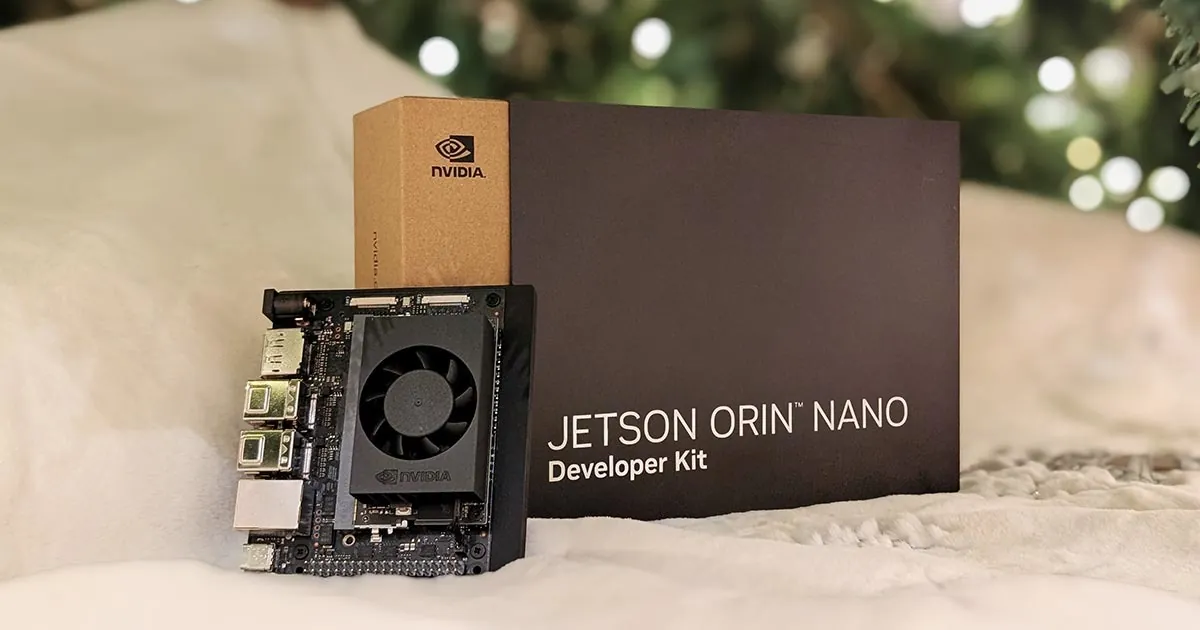
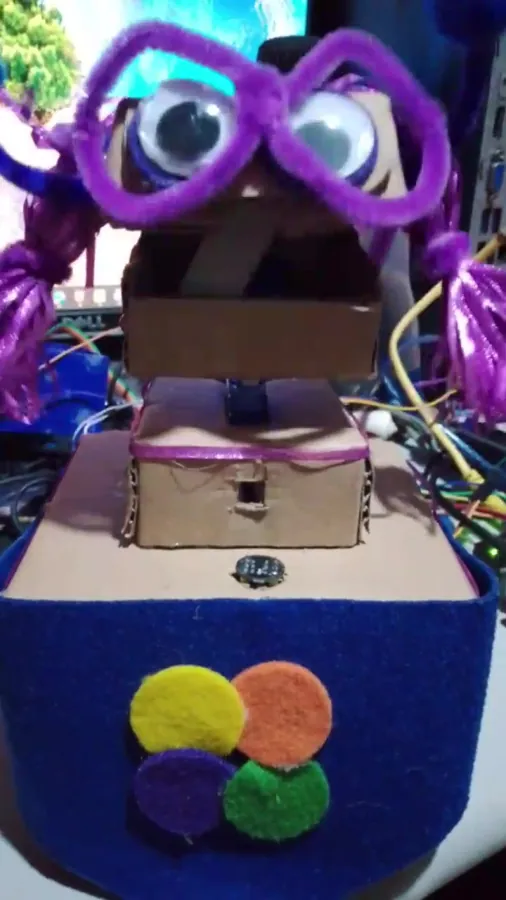
Built for real, built in public
One developer kit became a working robot, a content series, and a showcase at our 17th anniversary.
- Up to 67TOPS of AI compute on JetPack 6.2, in the palm of your hand
- 8 GBShared memory for vision, voice, and the LLM at once
- 10–15 WPower draw: runs off a powerbank, untethered
- 1,300+Tests in the open-source repo, no hardware needed
From unboxing to R&D showcase, in four Shorts
DEVCON Studios filmed the journey as it happened, so the community followed the build, not just the launch.
- 01Unboxing and first lookExploring the NVIDIA Jetson Orin Nano for the first time.Watch on YouTube (opens in a new tab)
- 02Edge AI engineering, for realWhat building on-device AI actually looks like day to day.Watch on YouTube (opens in a new tab)
- 03Meet the buildersA surprise interview with our AI Engineering Interns.Watch on YouTube (opens in a new tab)
- 04The showcaseWhen studying AI engineering feels like a celebration.Watch on YouTube (opens in a new tab)
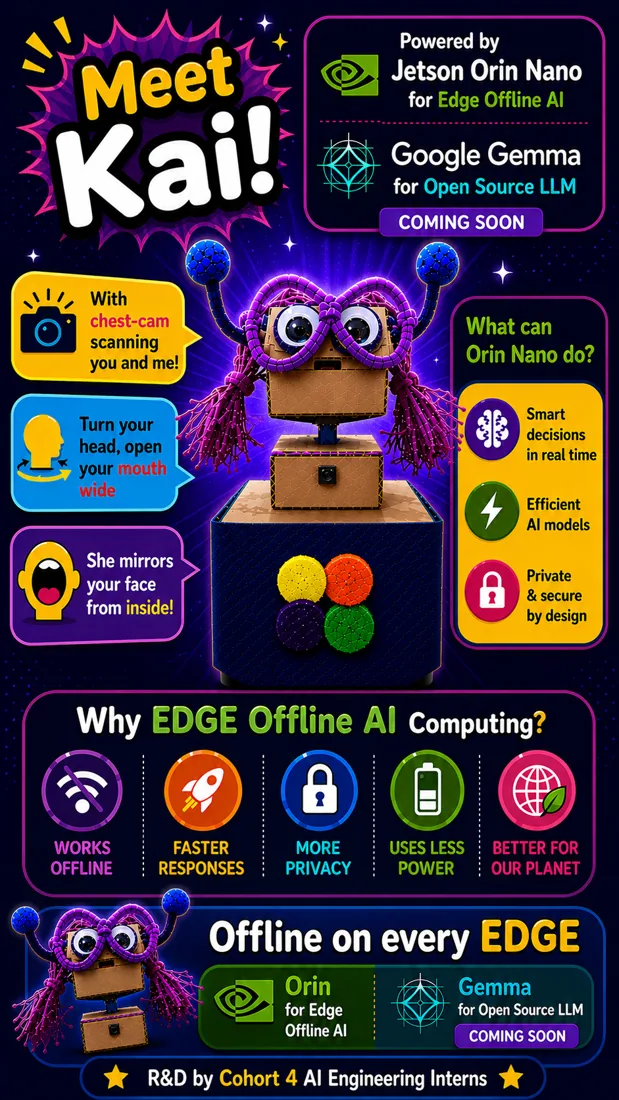
An edge offline AI robot that sees, listens, and responds
Kai thinks, sees, and responds entirely on the device. No cloud, no internet, and no data leaving the room. Turn your head, open your mouth, and Kai mirrors your face in real time.
- Sees you: MediaPipe FaceMesh tracks 11 facial parameters in real time, from a 320 by 240 camera feed.
- Follows you: a PD controller glides the head to whoever is in front of it, at 15 updates a second.
- Talks with you: wakes on “Hey Kai”, turns speech to text with Whisper, answers from its own documents with Google Gemma, and speaks with Piper, jaw in sync.
- Private by design: every workload runs on the device, with no cloud and no API keys on the path. Facial data is processed in memory only, and people are told before tracking starts.
From one servo to a robot with a personality
Three moments from the R&D, straight from the team’s phones.
- First servo testFace tracking on the Jetson drives a single servo for the first time.
- Cardboard prototypeThe head turns and the mouth opens, mirroring a face on screen.
- Kai, betaEyes, pigtails, and all: smooth head and jaw movement, ready for the stage.
Behind the scenes: what the highlight reel doesn’t show
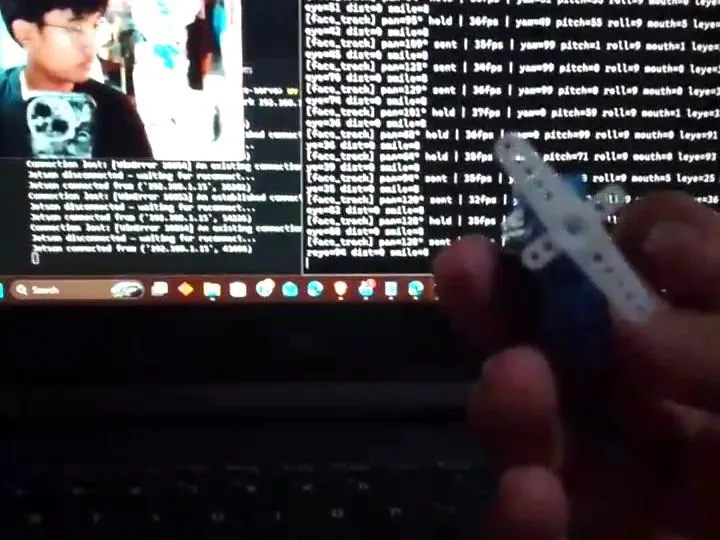
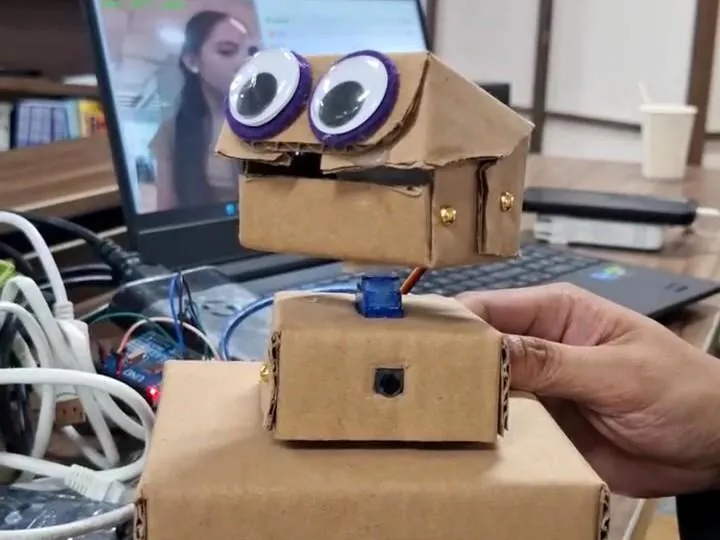
- 3.3 V won’t drive a servoJetson GPIO tops out at 3.3 V and SG90s need about 5 V, so an Arduino became the bridge.
- A dead servo mid-buildA faulty servo can buzz but not turn, leaving only one working servo.
- Missing wires, day oneThe first hardware test moved a day because parts weren’t checked beforehand.
- Brownouts drop the linkServos share the USB 5 V rail, and commands that are too fast can drop the connection.
What is the Jetson Orin Nano?
NVIDIA’s smallest edge-AI developer kit: a full computer the size of a paperback that runs modern neural networks locally, on the same CUDA, cuDNN, and TensorRT stack used in production edge deployments.
- 1,024-core Ampere GPUPlus 32 Tensor Cores and a dedicated deep learning accelerator (DLA).
- Up to 67 TOPS (INT8)Vision, speech, and an LLM at once. Full performance needs JetPack 6.2; earlier releases cap at 40.
- 8 GB LPDDR5, 102 GB/sOne shared pool for the CPU and GPU: the real ceiling for what fits.
- 6-core Arm Cortex-A78AEThe regular computer half, running Linux and the app code.
- 7 to 25 W, 5 nmSips power: Kai runs off a powerbank, no wall socket needed.
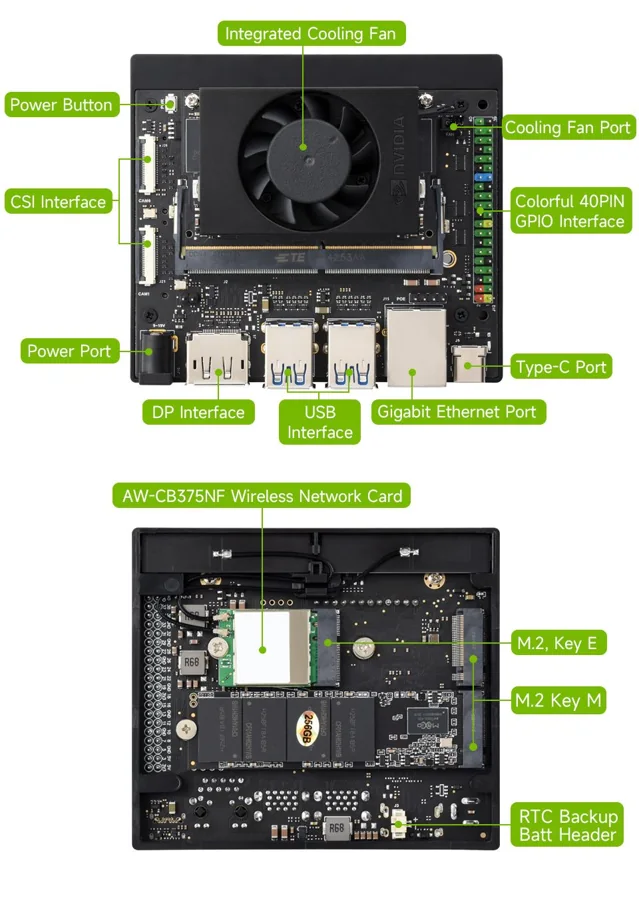
The NVIDIA compute stack, all on one 8 GB module:Ampere GPUDLACUDATensorRTcuDNN
Edge offline AI versus the cloud
| Cloud AI | Edge AI on the Orin Nano |
|---|---|
| Needs constant internet | Works fully offline, anywhere |
| Latency from network round trips | Real time, with no network hop |
| Data leaves the room | Nothing ever leaves the device |
| Fails where connectivity is poor | Works from a smart city to a far barangay |
For builders: ship into venues, clinics, and far barangays with no per-call cost and no data leaving the room. The deployment target is a box you own, not an API you rent.
How it all runs on 8 GB
Two independent pipelines run in one process, seeing and moving, and hearing and answering, sharing the jaw servo and the dashboard.
Seeing and moving
- CameraCSI or USB, 320 by 240
- FaceMesh15 fps, 11 parameters
- PD controlGlides at 15 Hz
- ServosPan and jaw, via Arduino
Hearing and answering
- Mic and wake word“Hey Kai”, voice detection
- WhisperSpeech to text
- RAG and GemmaAnswers from its documents
- Piper TTSSpeaks, jaw in sync
Why an Arduino? It acts only as a 5 V bridge. The Jetson’s GPIO pins top out at 3.3 V, which SG90 servos can’t reliably read.
8 GB of shared memory is the ceiling
GPU memory comes out of the same 7.6 GB the operating system and every process use. It’s the tightest constraint in the system, and the one you discover by crashing into it.
Memory budget, 7.6 GB total
What it forces
- A 2B model, not bigger: a 2 GB model stays resident; larger models push out the camera.
- Context capped at 2,048 tokens: raising it to 4,096 crashes the model runner.
- Whisper on the CPU: kept off CUDA to leave GPU memory for the LLM and vision.
- Embeddings on the CPU: retrieval runs on the CPU so it can’t compete for the GPU.
Expectations versus reality
Edge AI on 8 GB is a systems problem, not a model problem. Almost every win came from measuring what the hardware actually did, not from what the datasheet promised.
| What we expected | What actually happened |
|---|---|
| A bigger LLM would give smarter replies | A 4B model pushed out the camera. A 2B model is the largest that fits alongside vision in 8 GB. |
| A longer context window would give longer memory | Going past 2,048 tokens crashes the runner. GPU residency, not RAM, is the wall. |
| Voice noise settings would make Kai sound livelier | Measured: they changed intonation less than the noise floor. Hypothesis dropped and logged. |
| The wake-word matcher was the weak link | Three bugs, none in the matcher. A 0.35-second floor was silently eating the word “hey”. |
For builders: don’t trust the datasheet; measure on your board. The project changelog records the dropped ideas too, so you inherit the dead ends instead of repeating them.
From first servo to a shipping robot
Built in eight weeks on one Orin Nano, then hardened live at events.
- Jun 2026 · Shipped
Face tracking
- FaceMesh pipeline and PD controlOn a 15 Hz thread, with automatic USB driver loading.
- Jul 2026 · Shipped
Voice and RAG
- Push-to-talk speech to textGemma 2 (2B) with offline document Q&A and an editable persona.
- Late Jul 2026 · Shipped
Hands-free
- Piper voice and a “Hey Kai” wake wordAn always-open mic, with the jaw synced to real audio.
- Aug 2026 · Ongoing
Hardening
- Crash relaunch and fixesIdle loop cut from 185 to 22 Hz, jaw timing and dialect fixes, 1,300+ tests.
- Next · Planned
CUDA and TensorRT
- Move inference onto the GPUTo reclaim headroom for bigger workloads.
- Future
Level 2 autonomy
- From reacting to actingMulti-face awareness and richer on-device reasoning.
Ideas for Cohort 5
Same board, same offline-first constraint, new problems worth solving. Each idea builds on something Kai already proved.
Self-driving bot
A line- and obstacle-following rover, with a micro:bit handling motors and sensors and the Jetson doing the vision.
Builds on: the servo bridge and PD controlTaglish conversation
Natural switching between Tagalog and English in one conversation, not two separate language modes.
Builds on: RAG, persona, and delivery shapingBisaya voice
Cebuano and Bisaya understanding tuned per chapter, beyond canned filler lines.
Builds on: the dialect-aware filler bankA Filipino voice
Train a custom Filipino text-to-speech voice, since none ships for Tagalog, Filipino, or Cebuano today.
Builds on: the Piper TTS pipeline
Further out: NVIDIA Isaac Sim to train Kai in simulation first, and NVIDIA Omniverse for a real-time digital twin.
Who built Kai, and how to build on it
Cohort 4 AI Engineering Interns, DEVCON Philippines.
 Rhea PerochoDesign and buildDesigned and built Kai’s physical form: the cardboard body, the head, and the look that gives Kai its character.
 Jhondel MellomidaDeveloper and hardwareHandled the electronics and code: wiring, servos, the Arduino bridge, and the software that makes Kai see, listen, and talk.
Clone it, fork it, ship it
- Apache-2.0 licensed
- 1,300+ tests, runnable with no hardware
- Every constant annotated with the measurement behind it
- Full wiring, pinouts, and parts list in the docs
View Kai on GitHub (opens in a new tab)
For builders: reproduce this exact build, read why every number is what it is, and stand on the dead ends instead of repeating them.
How we tell builder stories with your tech
DEVCON Studios pairs your hardware or platform with real builders, then tells the story as it happens, to a community in 13 locations nationwide.
- Send us your techA developer kit, a board, a platform, or an API.
- Our builders go hands-onAI Engineering Interns run real R&D, documented as they go.
- DEVCON Studios tells the storyBuild-in-public Shorts, from unboxing to showcase.
- We showcase it nationwideLive demos at DEVCON events, and workshops for students and educators.
Our builders come from Jumpstart Internships, and the same hands-on model powers our Hermes Agentic Code Camp.
Put your tech in builders’ hands, and let us tell the story
Hardware makers, AI labs, and platforms: send us your tech and our builders will build with it in public, from unboxing to showcase, in front of the country’s largest volunteer tech community.
Discover other case studies and impactful results
- Hermes Agentic Code Camp and HackathonFirst in the Philippines: two weeks to national beta, 30+ builders shipped agentsRead the case study
- Mindanao AI CaravanFree AI education for kids, teachers, and builders in Bukidnon and IliganRead the case study
- micro:bit case study44 code camps; 86% of students more confident in codingRead the case study
- AI and Physical Computing for Educators95 educators from 32 schools built AI models and micro:bit prototypesRead the case study
- Sui × DEVCON: Build Beyond330+ Move smart contracts verified on mainnetRead the case study
- Hour of AI for Kids3.8k kids introduced to AI and coding, nationwideRead the case study
Sponsor the next one
Help scale build-in-public hardware R&D nationally, across 13 locations and beyond the capital.